Orbit Sentinel
Unmute
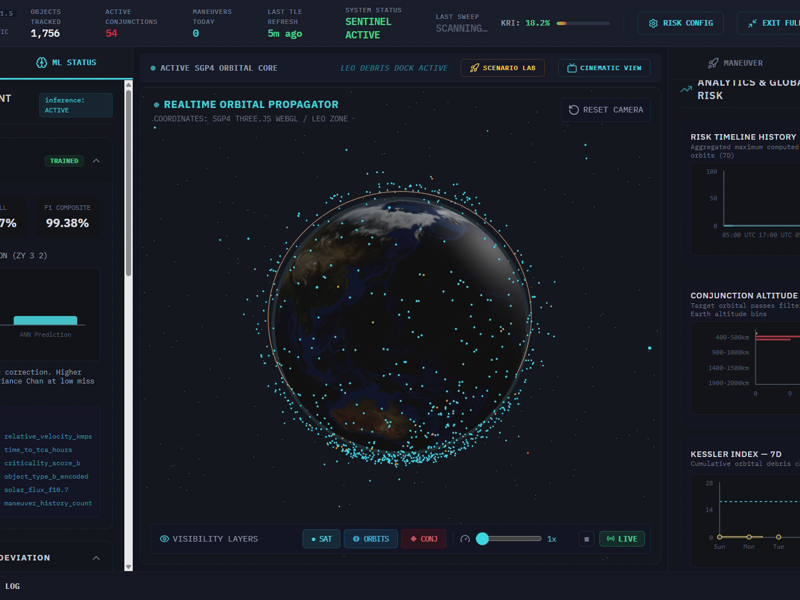
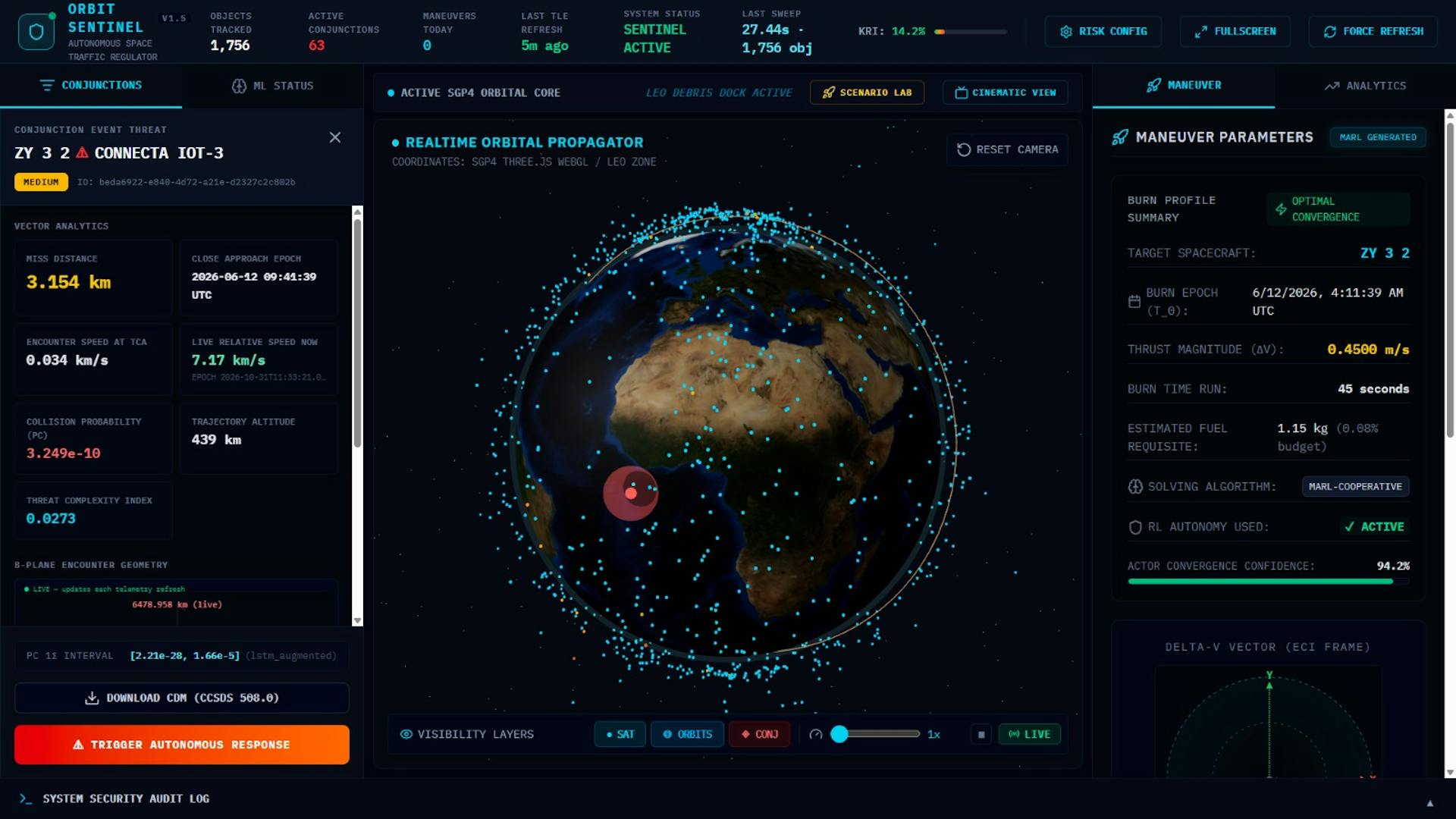
Orbit Sentinel is a production-grade, full-stack Space Situational Awareness (SSA) platform that ingests live Two-Line Element (TLE) data from CelesTrak, propagates 1,500+ satellite states in real time using SGP4, detects close-approach conjunction events through KDTree spatial indexing, computes physics-calibrated collision probabilities via the Chan/Foster analytical formulation, and autonomously plans fuel-optimal avoidance maneuvers through a stack of three ML models running in parallel — all visualised on a live 3D WebGL globe.
This is not a prototype. Every module — propagation, detection, probability computation, maneuver planning, cascade simulation — is built to aerospace engineering standards and validated against real historical collision data.
(Scenario lab available XD - GAME MODE)
This is not a prototype. Every module — propagation, detection, probability computation, maneuver planning, cascade simulation — is built to aerospace engineering standards and validated against real historical collision data.
(Scenario lab available XD - GAME MODE)
How much experience does your group have? Does the project use anything (art, music, starter kits) you didn't create?
Our team has a mediocre level of overall programming experience, but we used this project to learn complex concepts as we went. We built the core system modules—including the propagation pipeline, spatial indexing, collision probability engines, and parallel machine learning frameworks—from scratch to test our skills against real historical data. The application continuously streams live, external Two-Line Element (TLE) satellite tracking datasets directly from CelesTrak.
What challenges did you encounter?
• Slowed down by too much data: Trying to track over 1,500 satellites all at the same time caused our 3D map to lag and slow down.
• Complex math calculations: Getting the system to quickly calculate if two fast-moving satellites would crash into each other was very difficult.
• Getting multiple AI models to cooperate was also a challenging task
• Complex math calculations: Getting the system to quickly calculate if two fast-moving satellites would crash into each other was very difficult.
• Getting multiple AI models to cooperate was also a challenging task


Made with 💖 by robots running our open-source software and GraphQL APIs.