Doodle box
Unmute
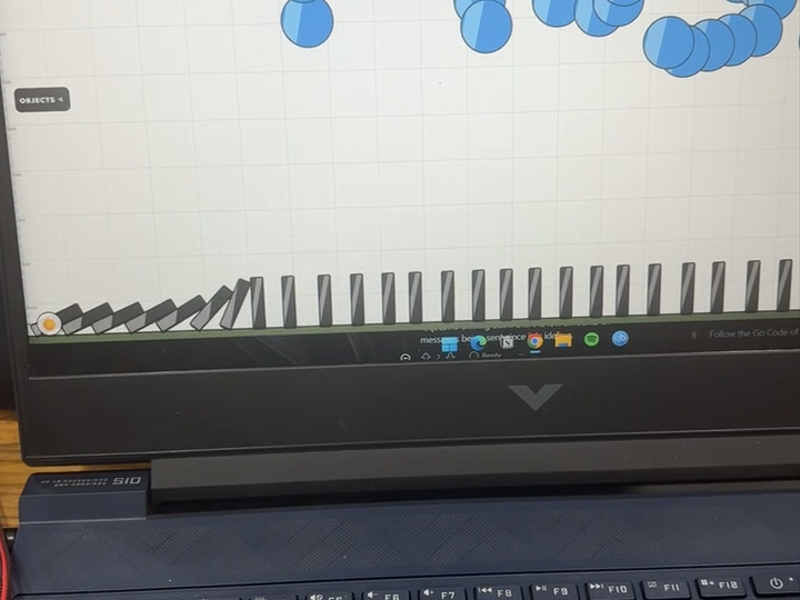
A physics sandbox environment where multiple users(players) can join by connecting to the same LAN. As multiple players join the same sesssion the canvas size of the sandbox increases.
THEME ADDITION: Multiple screens are connected horizontally in real time as an object exits the display boundry of a players screens it seemlesly enters the other players canvas with no delay and interupts its build. THIS HORIZONTAL REALTIME CONNECTION creates a seemless chain reaction.
GOAL? [ HOW TO WIN ] : As the HOST starts a new session (either free mode {we used just for debugging and fun} or time attack mode { this is the actuall competative mode where the players compete by building rube goldberg mechanisms to make the chain reaction pass from point A {i.e their starting screen bezzel } to B {their ending screen bezzel}. [ BTW THE CHAIN REACTION INCLUDES multiple objects , balls, heavy balls, dominoes etc].
The winner is decided by the equation [ No. of intractions * Time taken to complete the reaction in seconds ] { FUN FACT: the time taken is just used to set a random seed each game}.
in simple words they need to build a path for the B.
TECH STACK USED:
1. FRONT END : type script, vite , css
2. BackEND : Node.js, socket.io (websocket connections)
3. Physics engine : Matter.kjs with react.
AI DISCLOSURE : GEMINIE 3.1 UI. Physics engine self made functions. claude opus 4.5 for NODE .js to speed up simple boilerplate code.
THEME ADDITION: Multiple screens are connected horizontally in real time as an object exits the display boundry of a players screens it seemlesly enters the other players canvas with no delay and interupts its build. THIS HORIZONTAL REALTIME CONNECTION creates a seemless chain reaction.
GOAL? [ HOW TO WIN ] : As the HOST starts a new session (either free mode {we used just for debugging and fun} or time attack mode { this is the actuall competative mode where the players compete by building rube goldberg mechanisms to make the chain reaction pass from point A {i.e their starting screen bezzel } to B {their ending screen bezzel}. [ BTW THE CHAIN REACTION INCLUDES multiple objects , balls, heavy balls, dominoes etc].
The winner is decided by the equation [ No. of intractions * Time taken to complete the reaction in seconds ] { FUN FACT: the time taken is just used to set a random seed each game}.
in simple words they need to build a path for the B.
TECH STACK USED:
1. FRONT END : type script, vite , css
2. BackEND : Node.js, socket.io (websocket connections)
3. Physics engine : Matter.kjs with react.
AI DISCLOSURE : GEMINIE 3.1 UI. Physics engine self made functions. claude opus 4.5 for NODE .js to speed up simple boilerplate code.
What tools did you use to create your project?
How much experience does your group have? Does the project use anything (art, music, starter kits) you didn't create?
A group of 4 16-17 yo.
Beginner level python DSA experience (ISMAIEL), frontend (KAFEEL), design (musa), research/motivation (alyeem).
NO STARTER KITS USED
Beginner level python DSA experience (ISMAIEL), frontend (KAFEEL), design (musa), research/motivation (alyeem).
NO STARTER KITS USED
What challenges did you encounter?
1. Multiple project ideas confussion by teammates.
2. Websocket buffer overflow .
3. Websocket Multiple reconnections.
4. Physics integration.
2. Websocket buffer overflow .
3. Websocket Multiple reconnections.
4. Physics integration.
25
17
26
25

Members


Made with 💖 by robots running our open-source software and GraphQL APIs.